
By James Elliott, August 2, 2024
“James, this is Coach Hunt, you’re in”. Those words echoed in my mind as I stood there in my parent’s kitchen in disbelief. I had just received the phone call of my life. Erv Hunt, the head coach of the University of California at Berkeley (Cal) Track & Field team had called me to let me know he had successfully got me into Cal to be an athlete on his team. Erv, who wasn’t much for words, got straight to the point and asked, “I need your birthdate to complete the paperwork.” I answered, “today”. That’s right, I got the phone call that would forever change my life on my 18th birthday (nearly 33 years ago). After discussing a few more logistical items, we set up an appointment for me to drive down to Berkeley to meet with him. I was on cloud nine and my future was looking bright. What I didn’t know was the life lesson in integrity I was going learn from Erv five years later.
Erv Hunt had been the head coach of the Cal Track Team since 1973. At the time he was appointed the position, he was 25 years old, the youngest head coach in Cal history. Erv was born and raised in Fresno, CA. He played football and ran track, specifically the hurdles, for Fresno State. Upon graduation from college Erv was drafted by the Green Bay Packers where he played two seasons before a back injury forced him into early retirement. In 1972, Erv was hired by Cal head track coach Dave Maggard to be a sprints and hurdlers coach. When Maggard was appointed Athletic Director the next year, Erv was named his successor. Erv would go on to coach the Cal Track Team for 31 years, retiring in 2005.
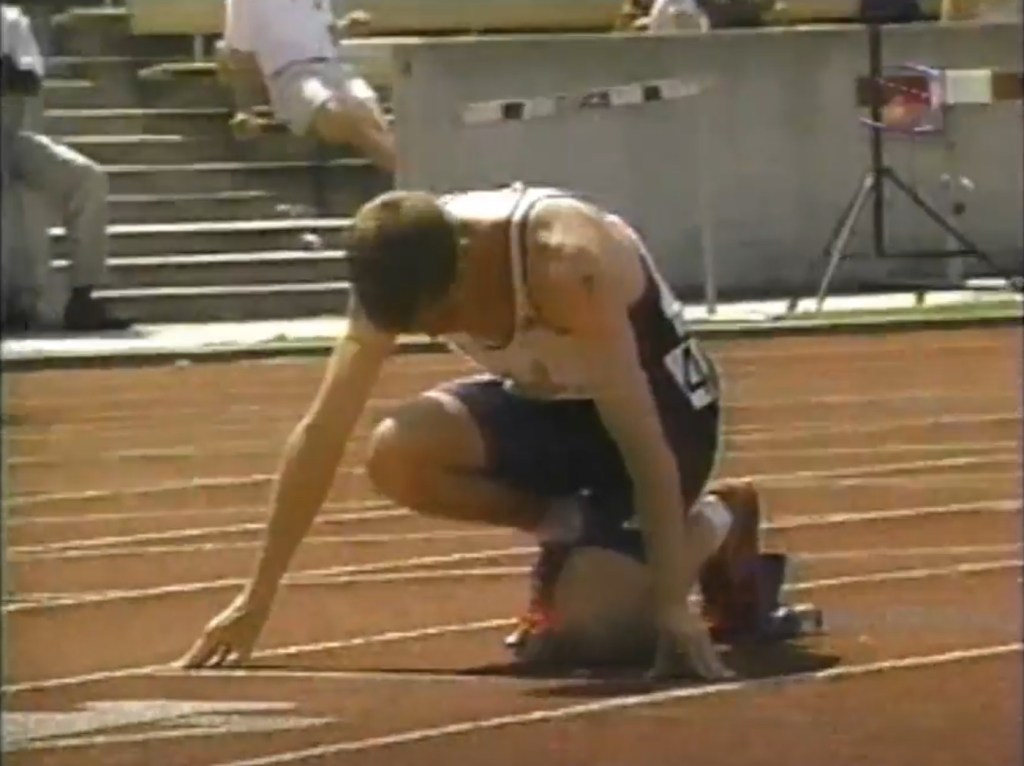
I joined Erv and Cal Bears Track Team in the fall of 1991. Like Erv, I was a hurdler. I ran both the 110m High Hurdlers and the 400m Intermediate Hurdles. I was also a member of the 4x400m relay team my senior year. But it was the 400m Hurdles where I would excel the most. Under the coaching of Erv, I would go on to have a successful collegiate track career that would culminate in winning the 400m hurdles at the 1996 California/Nevada Collegiate State Championships, placing 2nd in the 1996 Pac-10 Championships (behind Kenny Aladefa of USC, who was a Silver Medalist at the 1995 All African Games and would go on to represent Nigeria at the 1996 Olympics that year). I missed the 1996 US Olympic Trails qualifier by just one tenth of a second. All of this after having ACL reconstruction on my left knee my freshman year. But that’s another story.
Erv made a name for himself in the Track & Field world. This reputation led to him be named the Assistant Coach for the 1992 US Olympic Team for the games in Barcelona and then the Head US Olympic Team Coach for the 1996 Games in Atlanta. It was as the Head Coach of the US Olympic Team when Erv would provide, not only me, but the world, a lesson in integrity.
The head coach of an Olympic team is largely an honorary and administrative title. All of the athletes already have their own coaches, so you’re not getting into their business and coaching them in their individual events. The one main job of the head coach is to assemble the relay teams and to determine who runs in each race and in what position.
Even though the composition of the relay team is at the discretion of the Head Coach in accordance with rules set by USA Track & Field, traditionally the relay teams at the national level are made up of athletes who were in the final for their individual event. For example, the pool of athletes used for the Olympic 4x100m relay would be those athletes who were in the 100m final at the US Olympic Trials with the top four running the final in the Olympics. The same would go for the 4x400m relay as well. But you can’t run your top 4 athletes in every race from preliminary heats through the quarterfinals, semifinals and finals. Along with their induvial events, you’d burn the athletes out. So often the relay team at the preliminary and quarterfinals will typically include other athletes who placed 5th and 6th at the US Olympic trails, just to get the team though the initial rounds without burning out your main relay team athletes. In addition, this provides an opportunity for those who didn’t finish in the top 4 to run in the Olympics. It’s a win win. The arrangement works out pretty well, until someone upsets the apple cart and in 1996, the apple cart was upset.
Carl Lewis is a US Track & Field legend. Carl first became an Olympic household name at the 1984 Olympic Games in Los Angeles. At the 1984 Games, Carl won 4 Gold Medals in the 100m, 200m, Long Jump, and the 4x100m Relay. He would return four years later to the 1988 Olympics in Seoul, Korea and bring home 2 Gold Medals (100m and Long Jump) and 1 Silver Medal (200m). At Carl’s third Olympics at the 1992 Barcelona Games, he would win 2 Gold medals (4x100m Relay and Long Jump). Going into the 1996 Olympic Games in Atlanta, Carl already had a total of 8 Gold Medals and a Silver.
The 1996 Olympic trials did not go as planned for Carl Lewis. He only placed 3rd in the Long Jump, barely making the US Team in that event after struggling in the preliminary heats. This was the good news. As for the bad news, he finished dead last in the 100m final. This dashed his hopes of not only competing at the Olympics in the 100m, but practically speaking, also put him out of the running to participate on the 4×100 relay team as well.
During the 1996 Olympic Games Carl Lewis ended up winning the Gold Medal in the Long Jump. Enter the upset apple cart. After winning the Gold Medal, which was his 9th, he was looking for number 10 and had his sights set on the 4x100m relay. For the next week, Carl, who had not participated in any of the preliminary races for the 4x100m Relay, went on a media campaign. He started using his popularity along with his new Long Jump Gold Medal to apply pressure and lobby the US Track coaching staff to let him run in the 4x100m final so he could get his 10th Gold Medal. There was just one person standing in his way.
As the Head Coach of the US Olympic Track & Field Team it was Erv Hunt’s decision and his alone who would participate on the team for the 4x100m Relay. Despite all the hype from the media and other outside influences, Erv was not going to allow this pressure to dictate his decision. The final four for the US 4x100m team were chosen, and the team did not include Carl Lewis.
Despite the criticism he received in the media, especially when the US Team didn’t win the Gold Medal, he stuck to his guns and did the right thing. Carl Lewis hadn’t attended the mandatory training camp for the relay team. Carl finished last in the US Olympic Trails finals. There were 7 other men who finished in front of Lewis at the Trials and it would have been unfair to them to have Lewis jump in front of them just because he and media wanted a 10th Gold Medal.
I watch the entire saga on TV from my apartment in Berkeley. When Erv stood his ground and didn’t put Carl Lewis on the team, I was extremely proud of my coach. Erv Hunt demonstrated integrity to the entire world the summer 1996. He chose morals or medals. He was what every leader should inspire to be.
What does this example of integrity mean for you and your career? As leaders, integrity needs to be our primary core value. We will often be challenged and we must be willing to stand up, demonstrate integrity, and do what’s right. Doing the right thing regardless of who is watching (or not watching) and who is applying pressure is of utmost importance. So whenever your integrity is challenged and you’re being asked to do something that’s not right, take a step back and think of my former track coach and ask, “what Erv do?”
 High Adventure Leadership